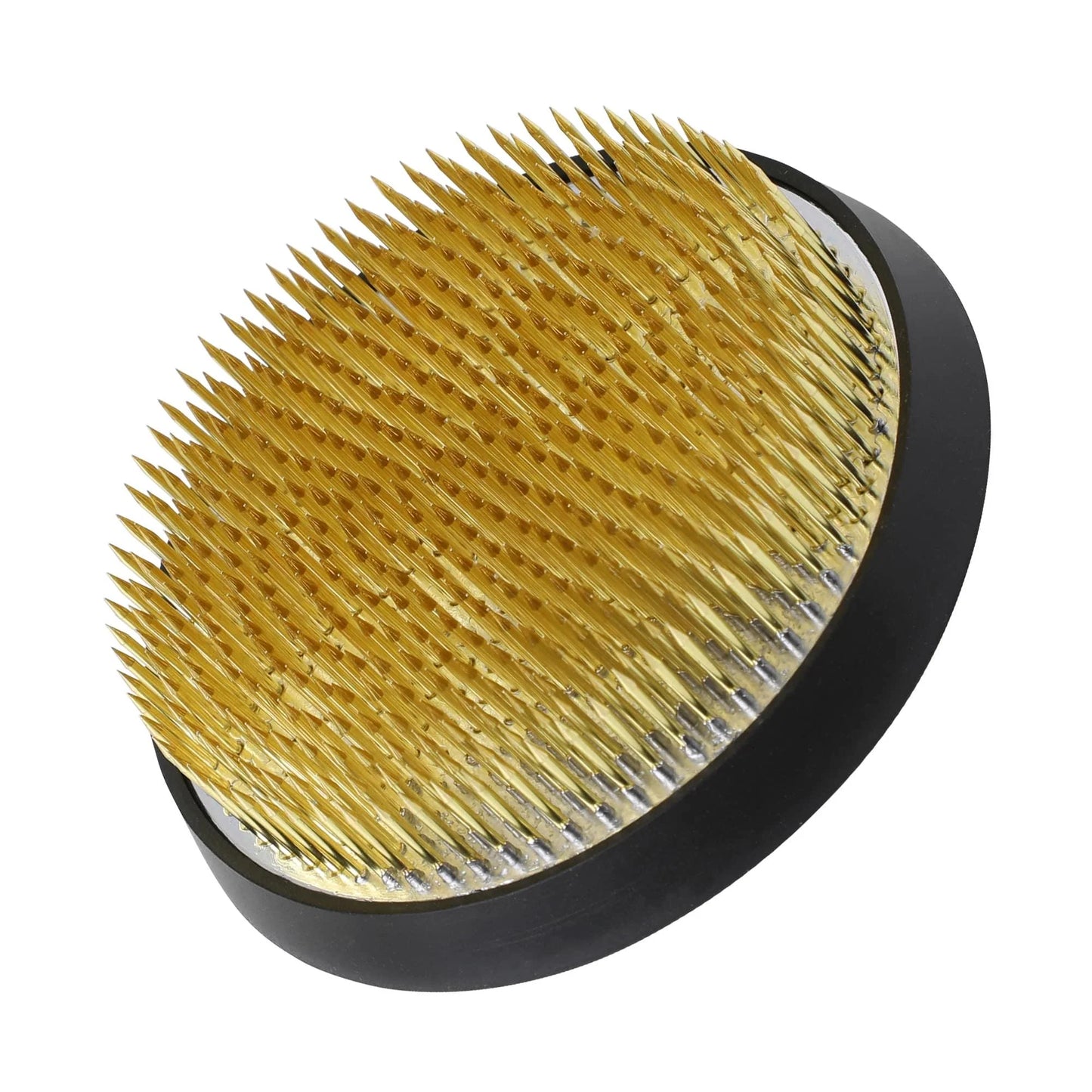
Brass Ikebana Kenzan
Brass Ikebana Kenzan
Wazakura
The kenzan is never seen. That is its function - to hold what is visible in precisely the right position, then disappear beneath the surface of the water. The Japanese call it 剣山, kenzan: sword mountain. The name fits. A field of brass spikes, each one 1.4mm across and 13mm high, arranged so densely across a weighted base that a stem pressed between them holds at whatever angle the arranger intends. The arrangement floats above. Below it, anchoring everything, is this.
These are made in Sanjo, Niigata, by artisans who have been working with metal for more than fifty years. The base and needles are brass - a choice with a logic behind it: brass resists corrosion, stays stable in water, and will not soften over the years of use a good kenzan is expected to give. The weight is considerable by design. The 61mm version is 247g; the 80mm, with its 331 needles, is 409g.
The rubber gasket on the underside can be removed for cleaning; it protects the vessel from scratching and keeps the kenzan in place.
Available in 61mm (168 needles) and 90mm (331 needles).
Brass. Made in Sanjo, Niigata.
Couldn't load pickup availability
About the maker
Sanjo, in Niigata Prefecture, has been a metalworking town since the 1600s - a place where blacksmiths have spent four centuries learning what fire and steel can be made to do. One workshop there, founded in 1912, is now on its third generation. The current smith, trained by his father as his father was trained before him, still forges bonsai scissors by hand, testing each steel and each edge against the last.
Wazakura exists to bring workshops like this one to a wider audience without asking them to change. Founded in 2019, the company works with master artisans across Japan - blacksmiths in Sanjo, and craftsmen in Miki, Toki, Yokkaichi and Tokoname - who build garden, bonsai, ikebana and woodworking tools the way they always have: forged and finished by hand, in small runs, using techniques passed down rather than engineered from scratch.
Nothing here is designed to be decorative. A pair of bonsai scissors, a chisel, a saw - these are tools first, made by people who have spent lifetimes making them well. Wazakura's role is simply to make sure that work doesn't disappear for lack of an audience.
$15 flat shipping, Australia-wide — free over $300.
View full details