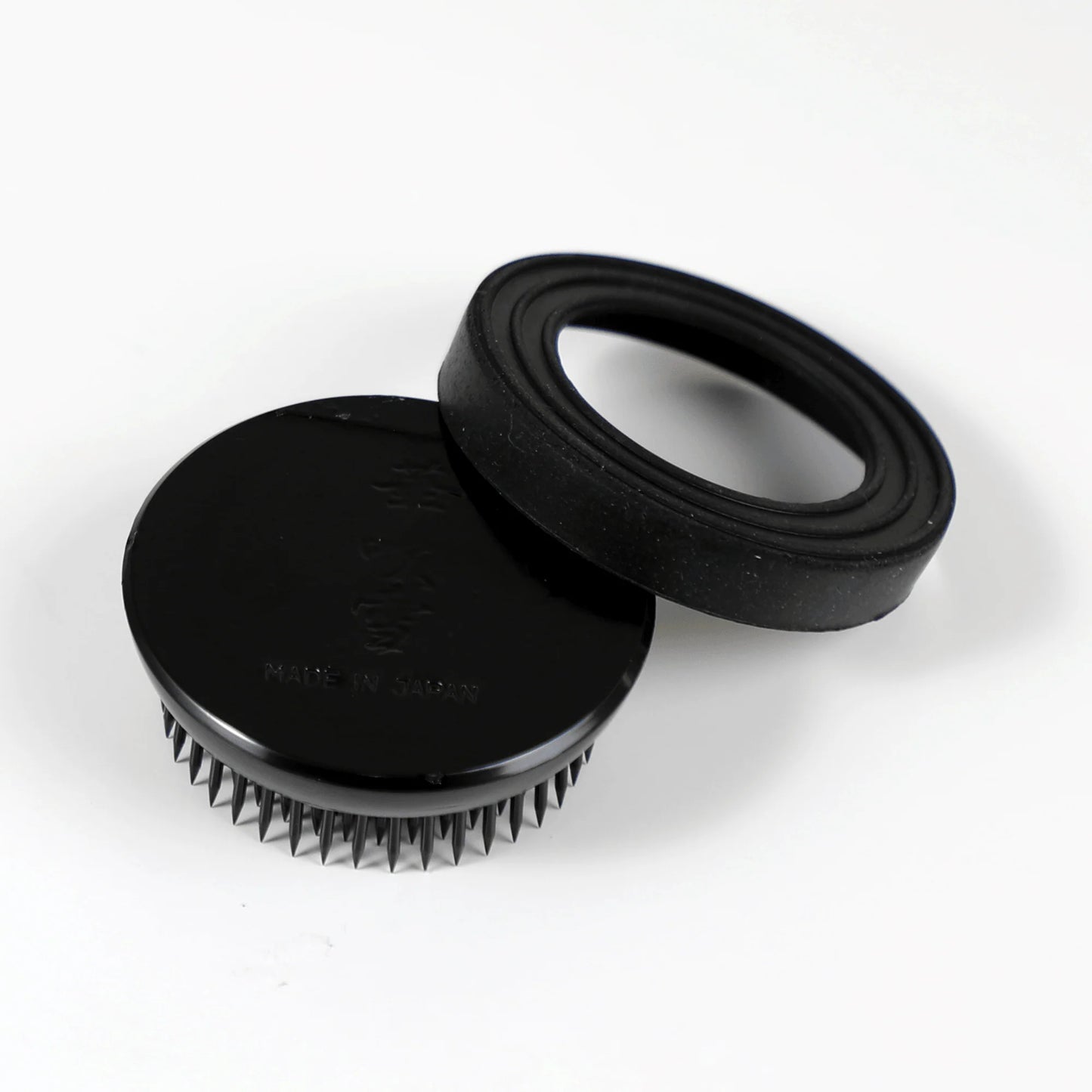
Black Ikebana Kenzan
Black Ikebana Kenzan
Wazakura
The city of Sanjo sits in Niigata Prefecture, on the Japan Sea coast, where the winters are hard and the metalworking tradition has been unbroken since the seventeenth century. The artisans here have spent their lives with brass and iron - shaping tools, hardware, cutlery - and the understanding of how metal behaves under pressure, over time, is not something that transfers quickly. It accumulates.
The kenzan is the hidden armature of ikebana: the dense bed of brass needles that holds a stem upright in water, invisible beneath the arrangement, doing its work in silence. This one is made by hand in Sanjo, black-coated so that it disappears against a dark vessel and gives nothing away. The needles - 168 in the smaller size, 331 in the large - are set into a solid brass base with a detachable rubber gasket. The needles are sharp and closely packed, made to hold heavy branches as well as the most delicate stems.
Couldn't load pickup availability
About the maker
Sanjo, in Niigata Prefecture, has been a metalworking town since the 1600s - a place where blacksmiths have spent four centuries learning what fire and steel can be made to do. One workshop there, founded in 1912, is now on its third generation. The current smith, trained by his father as his father was trained before him, still forges bonsai scissors by hand, testing each steel and each edge against the last.
Wazakura exists to bring workshops like this one to a wider audience without asking them to change. Founded in 2019, the company works with master artisans across Japan - blacksmiths in Sanjo, and craftsmen in Miki, Toki, Yokkaichi and Tokoname - who build garden, bonsai, ikebana and woodworking tools the way they always have: forged and finished by hand, in small runs, using techniques passed down rather than engineered from scratch.
Nothing here is designed to be decorative. A pair of bonsai scissors, a chisel, a saw - these are tools first, made by people who have spent lifetimes making them well. Wazakura's role is simply to make sure that work doesn't disappear for lack of an audience.
$15 flat shipping, Australia-wide — free over $300.
View full details