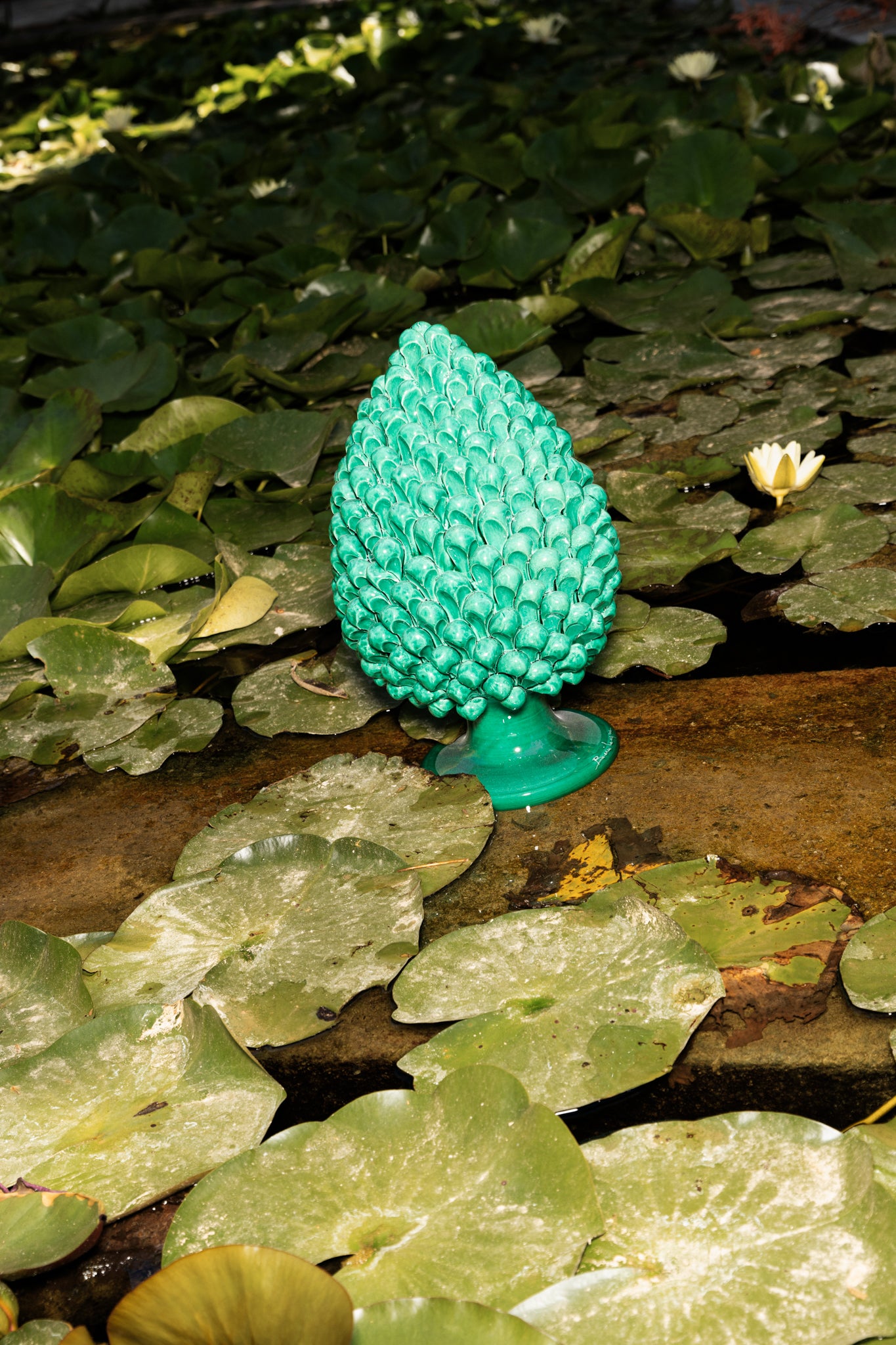
The pigna - the pinecone - is one of the oldest symbols in Sicilian decorative art. For centuries it has sat on gateposts and balconies across the island, placed there to welcome visitors and invite abundance into the house.
The traditional pigna is polychrome, piled with painted detail. Bevilacqua's range strips all of that away. What remains is the form itself - the scales, each one pressed on by hand; the pedestal; the quiet geometry of something made the same way for centuries. A traditional symbol, told in a contemporary voice.
Hand-built and hand-glazed by the Bevilacqua family in Campofranco, central Sicily.
No two are identical.
Couldn't load pickup availability
about the workshop
Ceramica Bevilacqua is a family workshop in Campofranco, a small village in central Sicily well off the tourist path. The workshop is run by two brothers, Antonio and Giuseppe, their wives Mariangela and Lorena, and Antonio's daughter Chiara. There are no other employees. Every piece that leaves Campofranco has been shaped, glazed, and painted by one of five pairs of hands.
Sicilian maiolica is a tradition more than a thousand years old, carried to the island by ninth-century Arab potters and shaped since by Norman, Spanish, and Italian hands. Bevilacqua's ceramics are painted directly onto raw tin glaze with mineral oxides - a process that allows no correction. What the painter paints is what the fire fixes forever. The Leopard imports their work directly from the workshop; it is available nowhere else in Australia.
$15 flat shipping, Australia-wide — free over $300.
View full details