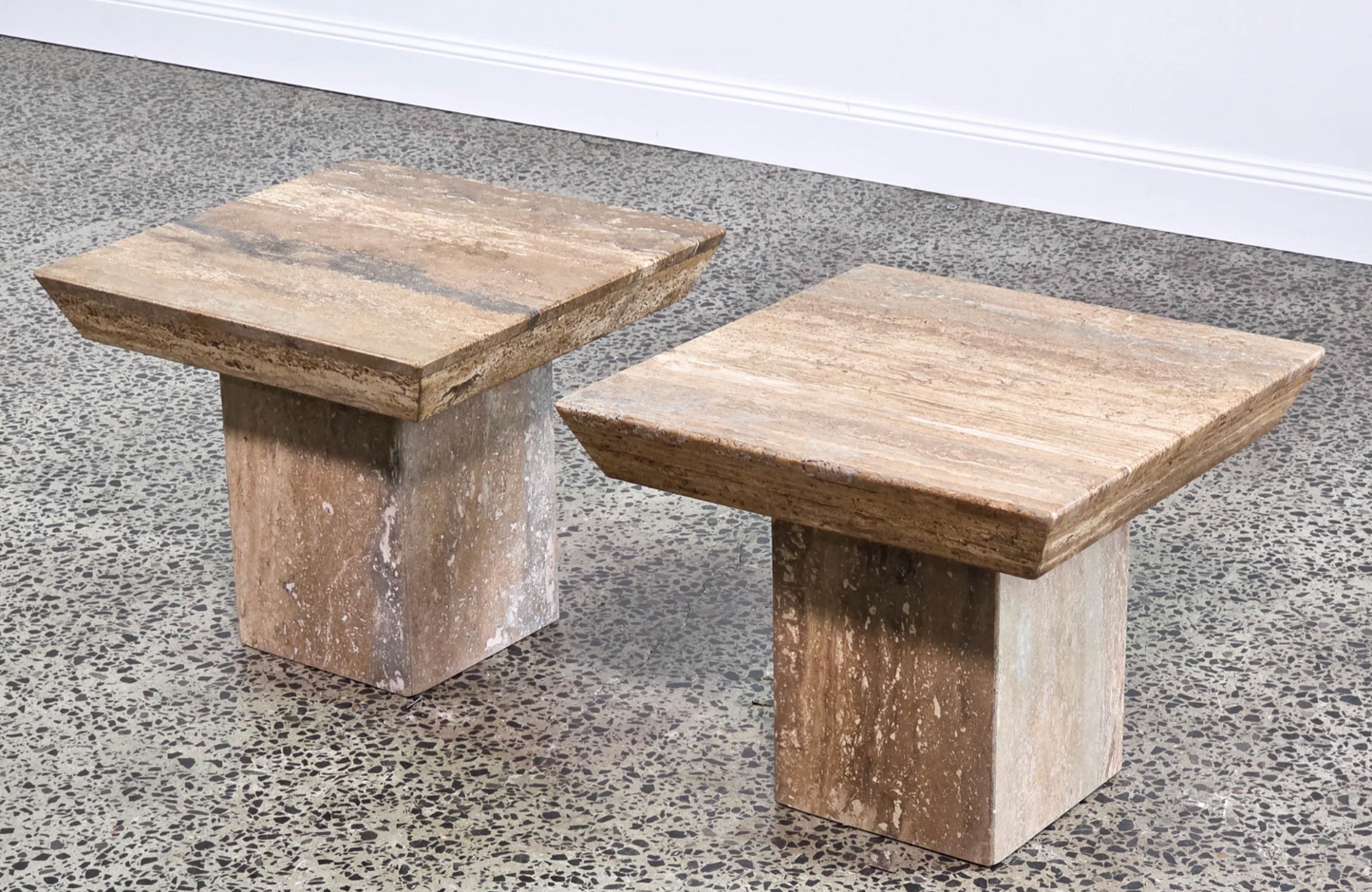
Pair of Italian Travertine Pedestal Side Tables: Mid-Century
Pair of Italian Travertine Pedestal Side Tables: Mid-Century
The Leopard
Travertine has been the stone of Roman building for more than two thousand years. Pliny the Elder called it lapis tiburtinus - the stone of Tibur, the Roman name for Tivoli - and the quarries at Tivoli, thirty kilometres east of Rome, have been cutting it continuously since the time of the Republic. The Colosseum is built of travertine; so are the colonnades of St Peter's, the Trevi Fountain, much of the Eternal City's civic architecture. The stone is the visible record of its own making: deposited by mineral springs over millennia, layered horizontally in bands of cream and tan, pocked with the small voids that mark where gas escaped during the slow geology of its formation. Italian designers in the mid-twentieth century brought it back into furniture. Travertine had the weight of architecture and the warmth of something domestic; it could be cut into monolithic blocks or thinned to slabs, polished smooth or left with its natural texture; and unlike marble it carried its history visibly, in those bands and voids. The 1970s in particular saw a boom of Italian travertine furniture - coffee tables, dining tables, side tables - heavy enough to anchor a room, quiet enough to disappear into it.
These two side tables are from that period. A pair of squat travertine pedestals, each composed of a thick square top set above a heavy block base; the stone shows the soft horizontal banding and the natural pitted texture of unfilled travertine, in cream, beige, and warm tan tones. The proportions are monolithic but compact - small enough to slip beside a chair, weighty enough to feel architectural.
Light surface wear consistent with age. The natural voids in the stone are part of the material, not damage.
Dimensions: H 0.45m × W 0.55m × D 0.55m (each)
Enquire about this piece via the form below.