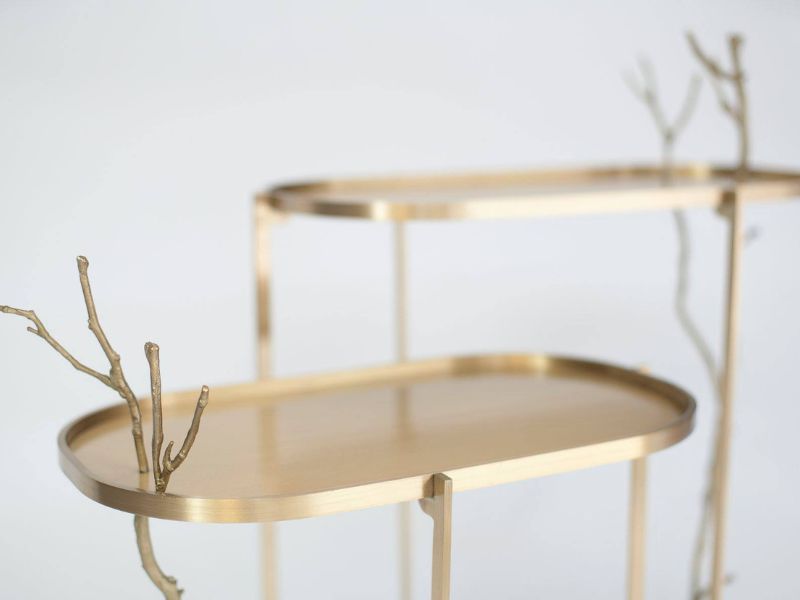
Khing side table pair
Khing side table pair
Sumphat
Sumphat Gallery works with more than thirteen artisan communities across Thailand, translating endangered craft traditions into objects for contemporary life, led by architect Rush Pleansuk.
In the galleries of Bangkok National Museum, the doors carry a particular kind of image: trees rendered in gold lacquer against dark grounds, their branches reaching across idealized sacred landscapes. The technique is called Lai Rod Nam. The tree is often the Khoi - Streblus asper, a resilient native species that Thai temple-builders have cultivated for centuries, as much for what it represents as for what it is.
Rush Pleansuk looked at those doors and asked what the image would become if you gave it volume.
The Khing side table is his answer: cast brass branches forming the silhouette of a solitary tree, rising from a sandblasted brass plate whose worked surface - textured to suggest wind-driven ripples - becomes the water. The two-dimensional sacred landscape becomes a three-dimensional object you place a lamp on.
Available in two heights. Cast and assembled by hand in brass. Exclusive to Australia at The Leopard.
Couldn't load pickup availability
Information
High: 31.5 × 61.5 × H 72 cm
Low: 31.5 × 51.5 × H 55 cm
Materials: brass plate, assorted brass moulded branches, sandblasted surface
About Sumphat
Rush Pleansuk trained as an architect in Thailand and France before turning to a different kind of construction. What he builds now is not buildings but continuity - the chain of knowledge between a tradition and its next practitioner, between a forgotten technique and a contemporary object that gives it reason to survive.
Through Sumphat, Pleansuk works with more than thirteen artisan communities across Thailand, translating endangered craft practices into objects for modern life. The method begins with research — into local narratives, material intelligence, ways of making that have not yet found their contemporary form. Then, collaboration. The result is not replication but renewal: something that carries history without being trapped by it.
Alongside him, French photographer Philippe Moisan - trained in ancient arts at the École du Louvre - brings a historian's eye to the work. His images translate the same sensibility: heritage as a living thing, not a relic.
Sumphat's work has been presented through Dior, Audemars Piguet, and Aman. It is exclusive to Australia at The Leopard.
$15 flat shipping, Australia-wide — free over $300.
View full details