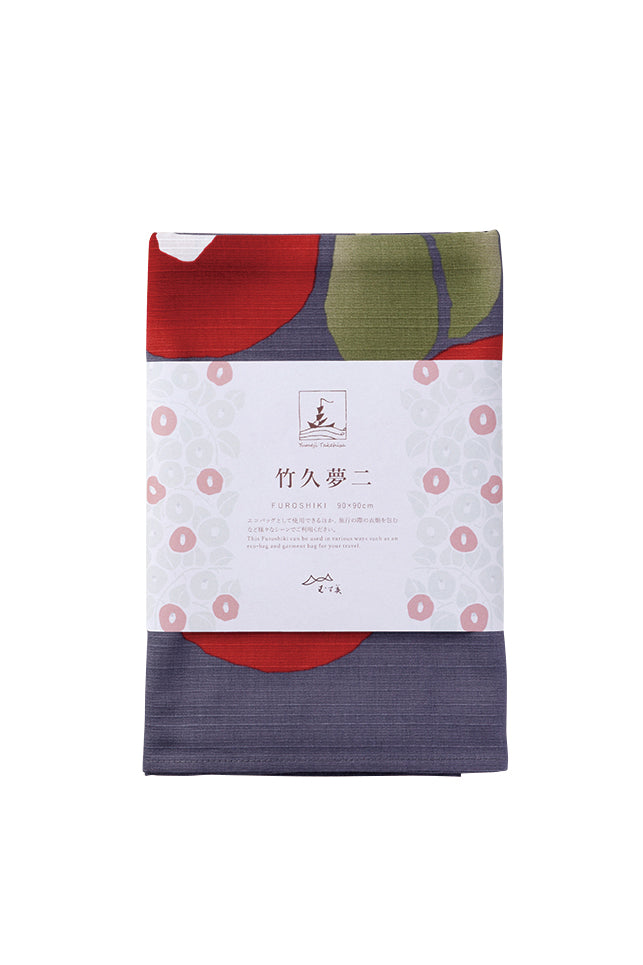
Furoshiki: Yumeji Takehisa, Camellia, Grey
Furoshiki: Yumeji Takehisa, Camellia, Grey
Musubi
Yumeji Takehisa (1884–1934) painted through the Taisho era, in the wistful, romantic style historians now call Taisho Roman - a brief cultural interlude between the formality of Meiji Japan and the militarism that followed. He was known for Bijinga, pictures of beautiful women, but he never confined himself to gallery walls. Yumeji designed for daily life - stationery, textiles, packaging, whatever people actually touched. Camellias recur through his work often enough to read as a signature.
Musubi prints one of those camellia patterns on cotton furoshiki, in bordeaux, at 90cm - sized for a bag, big enough to hold its shape once tied.
Made in Japan by Musubi.
Couldn't load pickup availability
About the maker
Furoshiki is older than any explanation for why it still exists. The Shosoin Treasure House in Nara has kept furoshiki in storage since it opened in 756 - cloth used to wrap and carry, unchanged in purpose for nearly thirteen centuries. In 1937, when Kyoto's Yamada Kanshichi Store first opened, furoshiki was still ordinary. Students carried their textbooks in it. People carried whatever else wouldn't fit in a bag.
The store became Yamada Sen-i, and the Yamada family has run it since: Koichi Yamada from 1966, his son Yoshio from 2003. In between, furoshiki stopped being ordinary - zippers and suitcases made it optional in a way it had never been. Musubi's response was not to freeze the cloth as heritage but to keep asking what else it could do: reversible dyeing that gives one square two patterns, water-repellent weaves, collaborations with the textile house minä perhonen, the artist Masaru Suzuki, the illustrator Adeline Klam. The techniques changed. The cloth did not.
Recent work is in organic cotton and recycled polyester as well as the old weaves. Furoshiki from the Kyoto workshop has been shown at the Tropenmuseum in Amsterdam and installed in front of Paris City Hall - a piece of cloth for wrapping things, still travelling.
$15 flat shipping, Australia-wide — free over $300.
View full details